
You’re sitting in the silence, wondering what it means.
You reach out. They pull back.
You try again. They pull back even further.
Suddenly, everything feels a little icy. Not angry. Not hostile. Just… less warm.
If you have an anxious attachment style, you may immediately assume the worst. Maybe they’re losing interest. Maybe they’re pulling away for good. Maybe this is the beginning of the end.
As a couples therapist in Bryn Mawr, Pennsylvania, I see this exact moment with couples every day. And what happens next is often very different from what people expect.
The silence that follows an anxious-avoidant cycle isn’t always a sign that the relationship is over. In many cases, it’s an opportunity to understand what’s really happening beneath the surface and begin building a more secure relationship.
Attachment theory suggests that people with anxious attachment styles often fear abandonment, while people with avoidant attachment styles tend to fear engulfment, dependency, or losing themselves in a relationship.
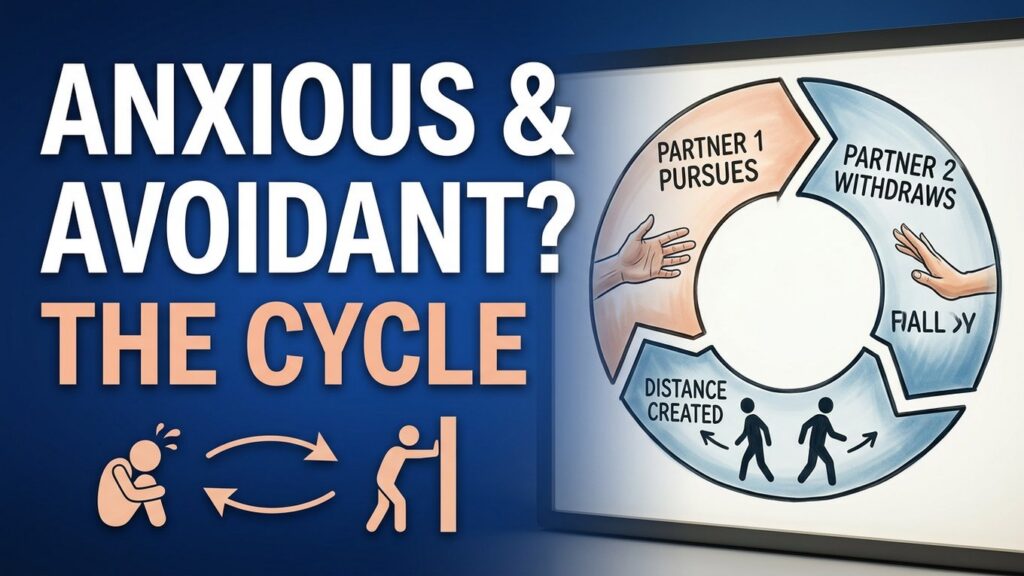
When these two attachment styles come together, they often create a painful cycle.
The anxious partner notices distance and seeks reassurance.
The avoidant partner experiences that pursuit as pressure and pulls away.
The anxious partner feels even more afraid and reaches harder.
The avoidant partner retreats further.
Eventually, both people become exhausted.
Then comes the silence.
Not the dramatic kind filled with yelling or slammed doors.
The quiet kind.
The kind where conversations become shorter, affection decreases, and both people begin wondering what happened.
One of the biggest misconceptions about avoidant attachment is that distance automatically means rejection.
Often, it doesn’t.
People with avoidant attachment styles frequently learned early in life that relying on others felt unsafe or disappointing. Perhaps caregivers were emotionally unavailable, inconsistent, or dismissive of their needs.
As a result, they developed an internal belief that self-reliance was safer than dependence.
When relationships become emotionally intense, avoidantly attached individuals may create distance as a way to manage anxiety and protect themselves.
Their withdrawal is often less about leaving and more about regulating.
Unfortunately, to an anxiously attached partner, that distinction can be almost impossible to see.
If you lean anxious, you’re likely responding to distance from a very different place.
The loss of warmth doesn’t feel like a request for space.
It feels like danger.
You may find yourself asking:
Are they upset with me?
Did I do something wrong?
Are they losing feelings?
Is this relationship ending?
Naturally, you reach out for reassurance.
You ask questions.
You try to reconnect.
You work harder.
But when those efforts don’t produce the closeness you’re seeking, you may eventually back away too—not because you want distance, but because it hurts to keep reaching and not receive the security you’re hoping for.
For a brief moment, both partners feel relief.
The pressure is gone.
The conflict is gone.
The pursuit has stopped.
But underneath that relief is often the same longing:
“I want to feel close to you again.”
Here’s something I wish more attachment experts emphasized:
The most important question isn’t:
“What attachment style do I have?”
The more useful question is:
“What is our dance?”
Because attachment labels don’t create relationship problems.
Patterns do.
And one of the most common patterns is what emotionally focused therapist Sue Johnson called the Protest Polka.
Sue Johnson used the term Protest Polka to describe the pursue-withdraw cycle that many couples experience.
One partner feels disconnected and protests the distance by seeking more connection.
The other partner experiences that pursuit as criticism, pressure, or failure and withdraws.
The more one partner pursues, the more the other retreats.
The more one retreats, the harder the other pursues.
Over time, both people become increasingly frustrated and disconnected.
What’s fascinating is that underneath the cycle, both partners are often asking the exact same question:
“Can I count on you to be there for me?”
They just ask it in very different ways.
Many people assume relationship problems happen during arguments.
In reality, much of the anxious-avoidant cycle happens in silence.
The anxious partner spends hours trying to figure out what the avoidant partner is thinking.
The avoidant partner spends hours trying not to think about it at all.
Both are reacting to the relationship.
Neither is talking about the relationship.
And that’s where couples often get stuck.
Researchers such as John Bowlby and Mary Ainsworth helped us understand how attachment patterns develop.
Research suggests that avoidantly attached individuals often use what psychologists call deactivating strategies—ways of suppressing attachment needs, emphasizing independence, and creating emotional distance when relationships feel overwhelming.
But suppressing emotions is not the same thing as resolving them.
The temporary relief that comes from distance doesn’t actually solve the underlying issue.
Neither does endlessly pursuing reassurance.
The silence serves a purpose. It allows everyone to catch their breath.
But eventually, you have to come back and talk about what happened.
If couples repeatedly disconnect, reconnect, and then never discuss the pattern itself, the cycle simply repeats.
My husband, clinical psychologist Dr. Michael Silverstein, often says:
“The worst time to fight is when you’re having a fight.”
The same principle applies here.
The best time to discuss your relationship pattern is not while you’re actively triggered.
It’s after you’ve both calmed down.
It’s when curiosity can replace defensiveness.
Instead of asking:
Try talking about the pattern itself.
Ask:
When couples stop diagnosing each other and start understanding the dance they’re doing together, real change becomes possible.
If you’re currently feeling disconnected from your partner, here are three places to start.
Before having a relationship conversation, regulate yourself.
Go for a walk.
Take a shower.
Practice deep breathing.
Try progressive muscle relaxation.
Do something that helps your nervous system settle.
Notice that none of these strategies require your partner’s participation.
Instead of telling your partner who they are, tell them what you’re learning about yourself.
You might say:
“When someone pulls away from me, every part of me wants to pull them back. I’m realizing I’ve been doing that for a long time, and I wonder what that feels like on your side.”
Or:
“I recently learned that some people pull away because they feel overwhelmed, not because they want to leave. Does that resonate with your experience?”
These conversations create curiosity instead of defensiveness.
Ask your partner:
“Do you think we get stuck in this pursue-withdraw cycle?”
Focus on understanding the relationship dynamic rather than proving who’s right.
One of the most hopeful findings from attachment research is that attachment styles are not life sentences.
Secure attachment isn’t something you’re born with.
It’s something that can be built.
When couples learn to recognize their patterns, talk about them openly, and respond differently, they create new experiences of safety and connection.
I’ve seen it happen countless times in my therapy office.
The goal isn’t to stop feeling anxious.
The goal isn’t to stop needing space.
The goal is to understand each other well enough that those differences no longer become threats to the relationship.
When couples stop blaming each other and start working together against the cycle, something remarkable happens:
The anxious partner feels less alone.
The avoidant partner feels less pressured.
And both people begin building the secure connection they’ve been looking for all along.
If you and your partner find yourselves stuck in the anxious-avoidant cycle, couples therapy can help you understand the pattern, communicate more effectively, and create a stronger sense of emotional safety.
Kim Fisel, LMFT is an expert in helping couples with the anxious-avoidant relationship trap. If you live near Philadelphia, she might be a good fit for you and your partner.
At Main Line Counseling Partners, we provide couples therapy in Bryn Mawr and online throughout Pennsylvania, helping couples move beyond pursue-withdraw patterns and build secure, lasting relationships.